

Success rarely happens by accident. Behind many women who consistently achieve their personal, professional, financial, and relationship goals is something simple but powerful: intentional planning. Successful women do not necessarily have more hours in the day than everyone else. They often become more intentional about how they use the hours they have. Instead of starting each week by reacting to messages, emergencies, requests, and endless to-do lists, they create a clear direction for where their time and energy should go. Weekly planning is not about filling every minute with work. It is about creating enough structure to make progress while leaving room for unexpected events, rest, relationships, and real life. Research on goal achievement supports the value of turning intentions into specific action plans. Studies on “implementation intentions,” for example, show that deciding in advance when, where, and how you will act can significantly improve the likelihood of achieving your goals.
So, what weekly planning habits can help a woman stay organized, focused, and ahead?
1. They Review the Previous Week: Before planning a new week, successful women take a moment to look back.
What did you accomplish?
What remained unfinished?
What consumed most of your time?
Which commitments were genuinely important, and which ones could have been avoided?
This simple reflection prevents you from repeatedly making the same planning mistakes. Instead of judging yourself for an unfinished task, ask:
“Why didn’t this get done?”
Perhaps the task was too large, poorly scheduled, or simply not important enough. Your answer can help you create a more realistic plan for the next seven days. Planning without reviewing can easily become a cycle of writing beautiful lists without understanding what actually works.
2. They Choose Their Top Priorities: One of the biggest mistakes people make is treating everything as urgent. Successful women understand that being busy is not necessarily the same as being productive. At the beginning of the week, identify three to five priorities that would make the week feel genuinely successful. These might include completing an important work project, studying for an examination, attending a professional meeting, working on a business, exercising consistently, or spending meaningful time with family. Your priority list should answer one question:
“If I accomplish only a few important things this week, what must they be?”
This makes decision-making easier when unexpected demands appear.
3. They Break Big Goals Into Smaller Actions: “Grow my business” is a goal.
“Contact five potential clients by Wednesday” is an action.
The difference matters. Large goals can feel overwhelming because they do not tell you what to do next. Breaking them into smaller tasks makes progress more visible and achievable. For example, instead of writing:
Improve my career
write:
Update my CV.
Complete one professional course.
Contact two professional connections.
Apply for three relevant opportunities.
Research on implementation intentions similarly suggests that specific plans linking situations to actions can help bridge the gap between wanting something and actually doing it.
4. They Use Time Blocking: A to-do list tells you what needs to be done. Time blocking helps determine when you will do it. Instead of saying,
“I will study sometime this week,”
choose a specific period such as:
Tuesday from 6:00–7:30 p.m.
You can create blocks for work, studying, exercise, errands, content creation, personal projects, appointments, and rest. This does not mean every minute needs to be scheduled. Leave breathing room because life rarely follows a perfect timetable. The goal is to give important activities a place in your week before less important activities consume your time.
5. They Plan Around Their Energy, Not Just Their Time: Not every hour feels the same. Some women think most clearly in the morning. Others become more productive later in the day. Your weekly plan should consider when you naturally have the most energy and concentration. Schedule demanding activities during your strongest periods whenever possible. Less demanding tasks, such as replying to routine messages or organizing files, can be placed during lower-energy periods. This approach can make your schedule more realistic than simply assigning tasks to empty spaces.
6. They Plan for “If-Then” Situations: One powerful planning technique is to anticipate obstacles before they happen. For example:
“If I feel too tired to exercise after work, then I will take a 20-minute walk instead.”
Or:
“If I receive an unexpected request during my focused work period, then I will check whether it is genuinely urgent before changing my schedule.” This type of planning is known as an implementation intention. Research has found that these specific “if-then” plans can support goal achievement and self-regulation. The idea is simple: don’t only plan for the perfect week. Plan for the obstacles that are likely to appear.
7. They Protect Time for Important Personal Goals: A successful woman is not defined only by how much she accomplishes at work. Your weekly plan should include your health, relationships, personal development, spirituality if important to you, hobbies, finances, and rest. If you only schedule professional responsibilities, everything else can become “something I’ll do when I have time.” And eventually, you may discover that you never have enough time.
Schedule what matters. A doctor’s appointment, exercise session, family dinner, reading time, personal project, or quiet evening deserves consideration just as much as a work meeting.
8. They Leave Room for Rest: Productivity without recovery can become exhaustion. Planning every moment of your week may look impressive, but it is not necessarily sustainable.
Successful planning includes downtime.
Give yourself permission to have evenings without major tasks.
Create space between demanding commitments.
Avoid filling every available hour simply because your calendar is empty.
Rest is not a reward you receive only after completing everything. It is part of maintaining the energy required to continue performing well.
9. They Learn to Say No: A weekly plan becomes meaningless if everyone else can constantly rewrite it. Successful women understand that protecting their priorities sometimes requires saying no. That does not mean becoming selfish or unavailable. It means recognizing that every “yes” consumes some combination of your time, energy, attention, or money. Before accepting an additional commitment, ask:
Does this support my priorities, or am I agreeing because I feel guilty saying no?
Not every invitation requires your presence. Not every request requires an immediate response. And not every opportunity is the right opportunity.
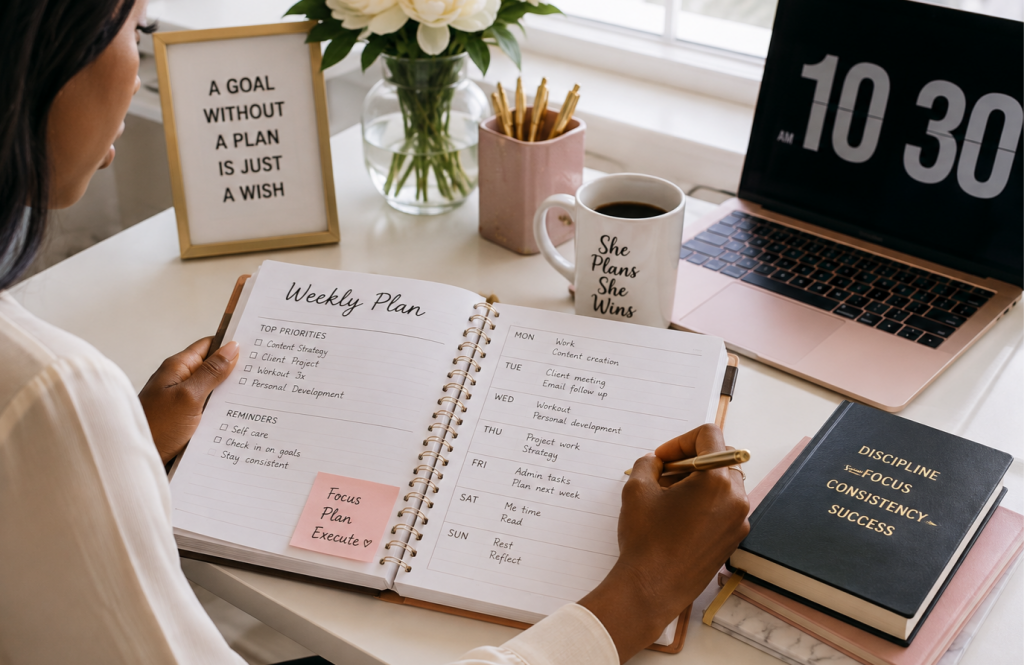
10. They Do a Midweek Check-In: You do not have to wait until Sunday to realize your plan is no longer realistic. A quick Wednesday check-in can help you adjust. Ask yourself:
What have I completed?
What is still important?
What needs to be rescheduled?
Am I taking on too much?
What can I remove from the list?
This prevents a small scheduling problem from becoming a completely overwhelming Friday.
A good planner is not someone who follows a plan perfectly.
A good planner knows when to adapt the plan intelligently.
11. They Prepare for the Next Week Before the Current One Ends: A short weekly review can create a smoother transition into the following week. Before finishing your workweek, record unfinished tasks, upcoming deadlines, appointments, ideas, and important reminders. This reduces the mental burden of trying to remember everything later. You can then enter the next week with a clearer mind instead of spending Monday morning figuring out where to begin.
12. They Keep Their Planning System Simple: You do not need an expensive planner, complicated productivity app, or a desk full of stationery to plan effectively. Use whatever system you can maintain consistently: a notebook, calendar, phone, digital planner, or combination of tools. The best planning system is not the most beautiful one. It is the one you actually use. Start with a simple weekly routine:
Review → Prioritize → Schedule → Act → Adjust → Reflect.
Repeat it every week. The Goal Is Progress, Not a Perfect Week. Perhaps the most important lesson is this: successful women are not successful because every week goes exactly according to plan.
Things happen.
Meetings run late.
Children get sick.
Work becomes unexpectedly demanding.
Opportunities appear.
Plans change.
Energy fluctuates.
The purpose of weekly planning is not to control everything. It is to give yourself a direction so that when life becomes unpredictable, you can return to what matters. You don’t need to become a woman who does everything. Become a woman who knows what deserves her time, what can wait, what she needs to delegate, and what she is willing to say no to.
Start with 20–30 minutes at the beginning or end of each week. Review what happened, identify your priorities, put important activities on your calendar, anticipate obstacles, and protect time for yourself. Over time, this small weekly habit can create something much bigger: clarity, consistency, confidence, and intentional progress.
Because staying ahead is not about rushing through life. It is about knowing where you are going; and making sure your weekly choices are taking you there.
LadiesUniverse; helping women grow, glow, and know their worth.
Research note: The planning principles above are grounded in research on implementation intentions and time-management self-regulation, including a meta-analysis of 94 independent tests and research examining weekly time-management behavior.