
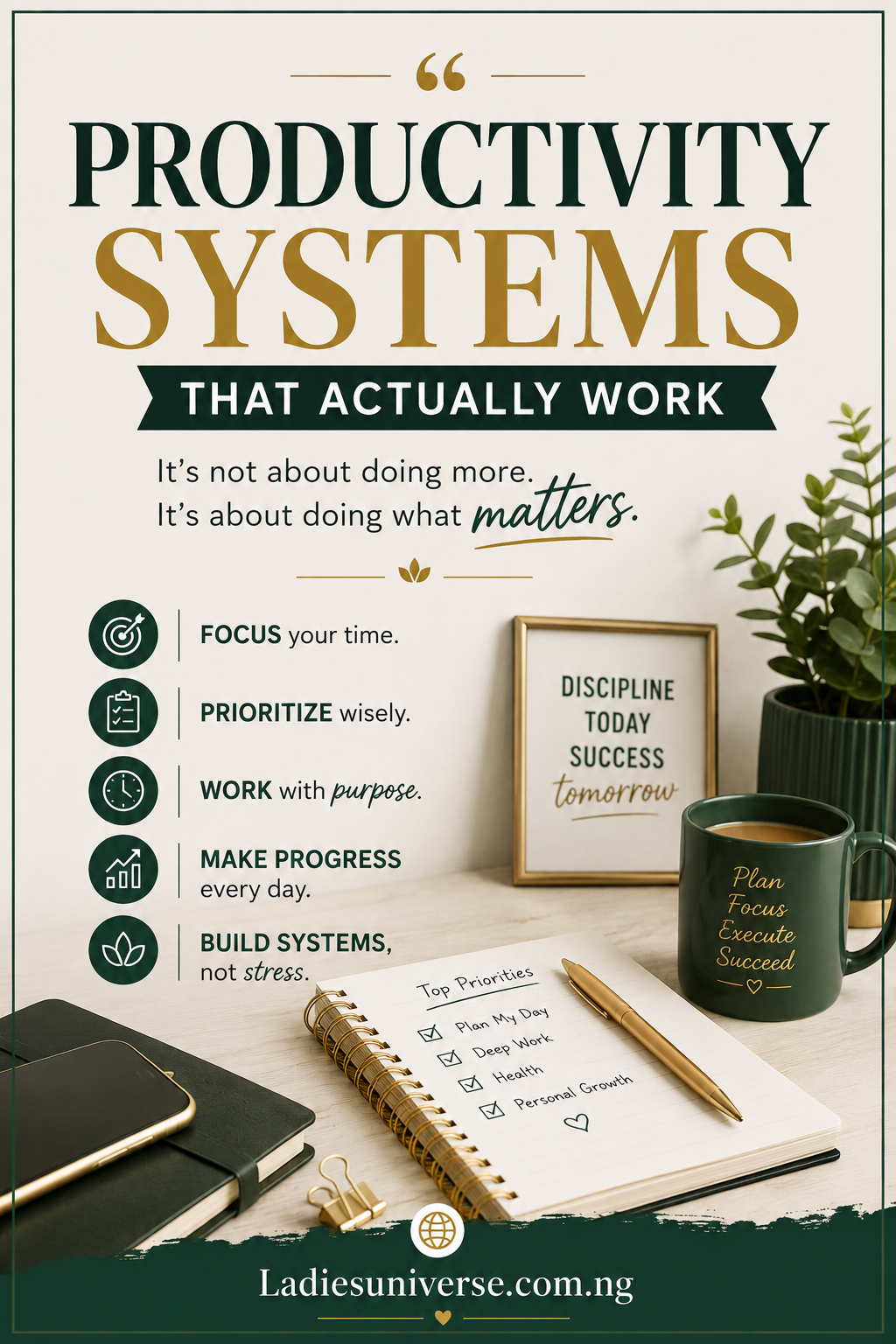
Being productive is not about filling every minute of your day with tasks. It is about using your time, energy, and attention intentionally so you can accomplish what truly matters. Yet with endless notifications, busy schedules, social media, work responsibilities, and personal commitments, staying productive can feel increasingly difficult. The good news is that you do not need to wake up at 5 a.m., work for twelve hours, or maintain a complicated planner to become productive. The right productivity system can help you organize your responsibilities, prioritize important work, and make consistent progress without constantly feeling overwhelmed.
Here are some of the most effective productivity systems and strategies you can adapt to your own lifestyle.
What Is a Productivity System?
A productivity system is a structured method for organizing your tasks, managing your time, and deciding what deserves your attention.Instead of relying entirely on motivation or memory, a productivity system gives you a repeatable process. It can help you answer questions such as:
What should I do today?
Which task is most important?
When should I work on it?
What can wait?
How can I avoid distractions?
How do I know whether I am actually making progress?
There is no single productivity system that works for everyone. The best approach is one that is simple enough to maintain and flexible enough to fit your real life.
The Eisenhower Matrix: The Eisenhower Matrix is useful when everything on your to-do list seems urgent. It divides tasks into four categories:
Urgent and important: Do these immediately.
Important but not urgent: Schedule time for these.
Urgent but not important: Delegate or minimize them where possible.
Neither urgent nor important: Consider eliminating them. For example, completing an important work deadline may be both urgent and important. Preparing for an examination several weeks away is important but not yet urgent. Scrolling through social media because you received a notification may feel urgent, but it is usually neither important nor productive. This system helps you distinguish between what is genuinely important and what merely demands your attention.
Time Blocking: Time blocking involves assigning specific periods of your day to particular activities. Instead of creating a long list and hoping you will find time to complete everything, you decide in advance when you will work on specific tasks. For example:
8:00–9:30 a.m.: Deep work
9:30–10:00 a.m.: Break
10:00–11:00 a.m.: Emails and messages
11:00 a.m.–1:00 p.m.: Project work
2:00–3:00 p.m.: Administrative tasks
Time blocking can reduce the mental effort involved in repeatedly deciding what to do next. It can also protect important tasks from being pushed aside by less meaningful activities. However, leave some flexibility in your schedule. A productive calendar should support your life, not control every minute of it.
The Pomodoro Technique: If you struggle with procrastination or find it difficult to concentrate for long periods, the Pomodoro Technique may be worth trying. The traditional approach involves working for about 25 minutes, followed by a short break. After several work sessions, you take a longer break. During each work period, focus on one task and minimize distractions. You can also adjust the intervals to suit your concentration span. For example, you might work for 40–50 minutes and then take a 10-minute break. The important principle is not the exact number of minutes. It is creating focused periods of work followed by intentional recovery.
The Two-Minute Rule: The two-minute rule is particularly useful for small tasks that accumulate throughout the day. If something takes approximately two minutes or less to complete, consider doing it immediately rather than allowing it to become another item on your mental list. For example, you could quickly reply to a simple message, put an item away, or file a document. However, do not interpret this rule as an instruction to interrupt important work constantly. If completing tiny tasks repeatedly disrupts your concentration, batch them together instead.
Eat the Frog: The phrase “eat the frog” refers to completing your most difficult or important task early rather than spending your entire day avoiding it. Your “frog” might be writing a report, studying a challenging subject, making an important phone call, or beginning a project you have been postponing. Once the difficult task is completed, other responsibilities may feel easier. This method is especially helpful when procrastination is your biggest productivity problem.
The 80/20 Principle: The Pareto Principle, commonly known as the 80/20 rule, suggests that a relatively small number of causes can account for a large proportion of results. In productivity, this idea can encourage you to identify the activities that produce the greatest impact. Ask yourself:
Which tasks are actually moving me toward my goals?
You may discover that answering every message, attending every meeting, or maintaining a huge to-do list is not nearly as valuable as completing a few high-impact tasks. The goal is not to obsess over achieving an exact 80/20 ratio. Instead, use the principle to identify where your effort produces the greatest return.

The Weekly Review: One of the most underrated productivity habits is reviewing your week. Set aside 15–30 minutes at the end or beginning of each week to ask:
What did I accomplish?
What remains unfinished?
What distracted me?
What should I stop doing?
What are my three most important priorities for next week?
A weekly review prevents unfinished tasks from continuously following you from one day to another. It also allows you to improve your productivity system instead of simply repeating the same habits.
Productivity Is Not About Doing More
One of the biggest misconceptions about productivity is that being productive means doing as much as possible. It doesn’t. Constantly working without adequate rest can eventually affect your concentration, mood, motivation, and overall wellbeing. Rest, sleep, movement, relationships, and personal time are not necessarily obstacles to productivity. They are part of maintaining the energy required to function well. A sustainable productivity system should help you accomplish meaningful goals while leaving room for life outside your responsibilities.
How to Choose the Right Productivity System
You do not need to adopt every productivity method you discover online. Start with your biggest problem.
If you constantly have too many competing priorities, try the Eisenhower Matrix.
If your days feel unstructured, experiment with time blocking.
If you procrastinate, try the Pomodoro Technique or Eat the Frog.
If small tasks overwhelm you, experiment with the Two-Minute Rule.
If you are busy but unsure whether your work actually matters, use the 80/20 principle.
You can also combine different systems. For example, you might use a weekly review to establish priorities, time blocking to schedule them, and Pomodoro sessions to complete focused work.
The best productivity system is not necessarily the most complicated one. It is the one you can realistically use consistently. Instead of trying to become busy all the time, focus on becoming intentional with your time. Identify what matters, remove unnecessary distractions, protect your attention, and give yourself permission to rest.
Productivity should ultimately make your life more manageable; not make you feel guilty for never doing enough.Start with one system, use it consistently for a few weeks, and pay attention to what works and what does not. Then adjust it until you create a productivity routine that fits your goals, your responsibilities, and your life. Because real productivity is not about doing everything. It is about doing what matters well.